Grief Practices for 2020 (Death and Mourning 2/5)

“I think a lot of it is rooted in the absence of rituals to practice grief, and to me decolonization is a death ritual. That’s what we’re talking about. We’re talking about letting go and releasing from what we thought, either for some people is what we thought we wanted and then for others what was imposed upon us and told made us citizens or worthy beings or valued beings, or declared that we were in fact alive. And I think we’re at a time in this concept of The Great Turning, that it will require pain, it will require grieving. It will invoke sadness. Because everything we thought was true, everything we were striving for is no longer, or now we know the impacts of what that old dream will impose upon the earth and other living beings. I think the growing pains of decolonization are valid. I think to be better organizers will require patience, and I think the problem is that the work is so urgent. So how do we metabolize that grieving process? What do we need to do to instigate that grieving process so that we can show up to the earth and to one another, urgently, and slowly, and how to find that quantum space to be here. And I think a lot of it can come through being transparent about the pain that we are in. And being witness in the grief that it is to shift.” – brontë velez in interivew with For the Wild

I wasn’t originally going to post this in my series on grief, but it is so applicable to this moment in time and so important. brontë velez speaks passionately about what it means to let go and grieve harmful living practices. They ask us to open ourselves up to grief, to recognize the need to create rituals that allow us to move into new spaces, and to welcome everybody into these spaces. Their interview titled ‘Embodying the Revolution’ with For the Wild speaks to many topics, one being the practices of grief competition, a.k.a., how even grief has become competitive in our society ruled by white supremacy. They ask us to consider how we can create grief practices that are inclusive and humble instead of divisive. They ask us to consider where and when your need for healing can be tended to:

“To me this work around grief competition can be grounded when we practice humility. This is a big thing I’ve seen a lot of spaces where people aren’t willing to be humble, aren’t willing to listen, aren’t willing to say, ‘Hey what are the other spaces where I can get the tending that I need to, and in this space maybe it’s not my voice that needs to be heard right now.’ And how to be in that wisdom and discernment.”

How can we move forward in our world? How can we enact a death ritual that lets us move away from oppressive institutions? How can we be okay with the unknown? How can we dismantle old structures and reimagine new futures?

“This is why I’m really interested in decomposition as rebellion, as was mentioned. Because decomposition as rebellion is saying, ‘I don’t know what is coming, I don’t know what’s happening, I don’t know what is next. All I know is that I need to die. All I know is that these things need to be laid to rest, that part I’m sure of.’ And how to just be committed to that is a powerful practice.”

Our world is changing, moving into a new phase (see this article by Nefeez Ahmed which talks about a global phase shift), and we must learn how to leave our old cultural practices behind. To me, as a white woman of privilege, grief in this form is acknowledgment, grief allows me to accept the fact that the white supremacist culture I was raised in is destructive and needs to end. I am grieving my late arrival in this space, but my grief opens me up to new possibilities and new understandings as I start shedding the skin of my old culture.

I highly recommend listening to all of brontë velez’s interview, because much more than just grief is covered. They are one of the many black leaders that are working on bringing our world into a better future.

Follow brontë velez on instagram at @littlenows, follow/donate to her organization Lead to Life.

References:
Ahmed, N. (2020, June 5). White Supremacy and the Earth System. Medium. https://medium.com/insurge-intelligence/white-supremacism-and-the-earth-system-fa14e0ea6147
Young, A. (Director). (2018, Feb 15). brontë velez on Embodying the Revolution [Audio Podcast]. Retrieved from https://forthewild.world/listen/bront-velez-on-embodying-the-revolution.

The Dying of the Coral and Green Consumerism

“In the lagoon, before when I was young, we went to swim and it was full of coral, full, full, full of pretty ones. Now, there aren’t any more. Now, there aren’t any more…. Before we had many urchins, now you find much, much less…. When you dive now, you see out there that the corals are no longer there. They are dead. We don’t understand. The only analysis that we have had is maybe that this comes from global warming. This is what we think, ours is not the opinion of a scientist, because we do not understand why.” – Louise Tehina Teikipupuni of Hapatoni

In the Marquesas, as in many other places around the world, the corals are bleaching. I talked to many divers on the island of Tahuata who reported the same, that the colors on the bottom of the ocean were dimmer than before. The Marquesas Islands are fortunate to not be low-lying atolls like their neighbors the Tuamotus, so their whole existence isn’t threatened by rising sea levels, but that doesn’t mean that they aren’t affected by the changes a warming world has brought. Bleaching coral, disappearing species, and the mysterious toxin known as ciguatera are all changes Marquesans have been facing.

In these times of environmental unpredictability, with large groups of youth protesting worldwide, I join them in asking everybody out there to do what they can to fight against irreversible environmental damage. Not all of us can dedicate our lives to the movement like Greta Thunberg, but even the smallest acts can lead us on the right path. Our world can often seem disconnected from natural resources and cycles, but this isn’t so. Everything we use comes, in some way, from nature. For indigenous scholar Robin Wall Kimmerer, the Earth has endowed us with many beautiful and useful gifts, and these gifts put us into an important relationship of reciprocity with nature that we aren’t currently honoring. Kimmerer writes, “Cities are like the mitochondria in our animal cells–they are consumers, fed by the autotrophs, the photosynthesis of a distant green landscape. We could lament that urban dwellers have little means of exercising direct reciprocity with the land. Yet while city folks may be separated from the sources of what they consume, they can exercise reciprocity through how they spend their money. While the digging of the leeks and the digging of coal may be too far removed to see, we consumers have a potent tool of reciprocity right in our pockets. We can use our dollars as the indirect currency of reciprocity” (Kimmerer 2013: 195). Kimmerer reminds us that even if all we can do is buy one ‘green’ item off of our shopping list, this action still counts.

Although far removed from the tropical islands of the Marquesas as I sit and write this in my Minnesota home, maybe the thoughtful use of my dollars can help the remaining corals stay alive just a bit longer. And so I will buy the vegan shampoo, local vegetables and recycled clothing with thoughts of my friends on Tahuata.

For more information about how to be more environmentally conscience with your consumption patterns, visit Environmental Consumer or simply take Kimmerer’s advice and by trying to imagine the origin of each item you purchase and all the processes it had to take to get to you.

Dead coral piled up on the shoreline in Hapatoni. Photo from May 2018.

References:

Kimmerer, R.W. 2013. Braiding Sweetgrass: Indigenous Wisdom, Scientific Knowledge, and the Teachings of Plants. Canada: Milkweed Editions.

Conversations with Teifituteiki (2/2) – On Getting Old

“He says he had three boats. They were there, he went fishing, he taught his children. He taught his children how to fish, and after awhile he started to get old, alone. And there you go, he stopped fishing a little bit. But, for the morale, he still has the morale to go fishing! Oh yes, he still has the morale. It is enough if somebody comes to find him, ‘Let’s go fishing.’ He will go. He will not wait. He gets up, and he prepares.”

Fishing is often not just a livelihood for Marquesans, but also a pastime. Many fishers talk about “la maladie de la pêche,” or the fishing illness, in which fishers “go crazy” if they haven’t been out on the sea in awhile. As fishers get older, it becomes harder to get out fishing–especially in villages like Hanatetena, where the sea is often rough–but, they often can’t shake the deeply ingrained longing that a true Marquesan fisher will always have inside.

Teifituteiki walks up the road towards the church in Hanatetena.

Original French:

Il disait, il avait trois bateaux. Etait la, il ete a la pêche, il a appris ces enfants. Appris ces enfants pratiquer la pêche, et puis après il a commencé etre vieil, seul. Et voila, il a un peu arrêter la pêche. Mais, pour la morale, il a toujours la morale de aller a la pêche! Ah oui, il a toujours la morale. Il suffit que quelqu’un vient le chercher, ‘on va a la pêche’ s’aller. Il va pas attendre. Il se lève, et il se prépare.

Conversations with Teifituteiki (1/2) – the To’a

“For the to’a, he looks to landmarks to find the good [fishing] spots, to be able to fish the deep water fishes, i’a to’a. For the signs, he looks to crevices, trees… trees, crevices and sometimes a mountain to find the spot. He says it’s like this: when the fish bite, he looks to the mountains and takes mark of the signs. For the day after tomorrow, or perhaps for the next fishing trip. When he returns, he goes again to the same spot. He says it is truly sad for the youth, who do not know this type of fishing. Here mostly in Hanatetena, he says that maybe it is the parents that have not transmitted [the knowledge], or the parents were not fishers. This is what he says.”

Tehei translates the words of Teifituteiki (or simply, Papa’u Teiki), an old fisherman from the village of Hanatetena who speaks in his local language, Marquesan. I discussed fishing practices with him back in April of 2018. The Marquesan word to’a refers to deep-sea fishing locations, usually plateaus or rocks that provide decent feeding grounds around which large fish congregate. The practice of finding the to’a using landmarks is an ancient technique used by Marquesan fishers to this day, and may be one of the last places in the world where it continues to be practiced. Fishers triangulate two or three landmarks by moving their boats and bodies through space until the landmarks align just right. Like much of the older generation on Tahuata, Papa’u Teiki laments the changes that have taken place.

Original Transcription:

Sur le to’a, il regarde les signes pourqoui il trouve le bon endroit. Pour pouvoir pecher les poissons du fond, i’a to’a. Pour les signes, il regarde dans les cretes, les arbes… les arbes, les cretes et parfois une montagne, pour trouver le endroit.
Il disait, c’est comme ça: quand se mord les poisson, il regarde sur la montagne pour marquer les signes, pour la lendemaine, ou pour la prochaine pêche. Quand il revint, encore au même endroit.
Il disait, c’est vraiment dommage pour les jeunes, qui ne connaît pas cette pêche la. Ici surtout Hanatetena, il disait peut être c’est leurs parents n’a pas transmettent, ou leurs parents sont pas des pêcheurs. C’est-ce qu’il dit.

Plastic Beaches

“You see the plastic from the sea? It stocks up on the beach. It is full of it there. I think it’s because of this that fish do not come to our waters anymore, they look for places that are good. I say this often during political meetings – ‘we need to go pick up all this stuff there,’ but they don’t move. It’s not good for the environment. And it’s a beautiful beach. I lived in that valley. For about four years, I lived there when I was young, when I went hunting. It’s not good. You will find nets, plastic bags, bottles, it is full of them, there is everything. It’s just above Motopu – a small village above. You say to your [government] ‘give me money so that I can go pick it up’ you say this to your [government]. You have to say this. It’s best. Because like this, soon the Marquesas will be dead. It will die.” – Kiki, Vaitahu, Tahuata

Plastic pollution is a problem for many Pacific Islands. Ocean currents bring plastic from far away places, but also from local sources of pollution. Unfortunately, islands like Tahuata do not always have the resources to clean up these beaches, nor is everybody aware of this pollution. Kiki was one of few islanders who spoke to me directly about this plastic problem, possibly because of his personal connection with the beach in question. Kiki implores the government to do something about this issue, but he says, “They don’t listen to us.” Just cleaning up the beach will not bring an end to the problem, either. Behaviors must be changed as well, both locally and globally.

Fishing vs. Drinking

“Here, there are many young people that practice fishing. Over in Vaitahu, they practice drinking!”

I’m visiting the village of small Hapatoni, one of four villages on the island of Tahuata, when Tehei makes this joke about the drinking problems of the people in his village. We are sitting around an outdoor work bench with three women whom I am interviewing for my research on Marquesan fishing practices. Rose is the mother of Franceline and Myrna, both in their thirties. While Myrna has answered most of my questions throughout the interview, Franceline and Rose have chimed in as well, and do so more towards the end. We have been discussing differences between Hapatoni and Vaitahu in terms of fishing practices. Vaitahu is a bigger village, and the main port of the island of Tahuata. It is a twenty minute drive from Vaitahu to Hapatoni. Tehei begins discussing the differences between the two villages with this joke about beer: Although Tehei jokes, making the others laugh, I can’t help to notice the satirical truth in his words.

Rose continues to explain how important fishing is in her village:

“Even the children [fish] here, eh? Sometimes, they take the fishing cane and they go to the beach. Afterwards, they return home with their fish and say, ‘Voila, here’s my fish, it’s 500 francs!”

Here, Rose also deliberately jokes about social novelties: the new prevalence of the cash economy in today’s society. Earlier in the interview, when asked about changes that have occurred to the village, Myrna doesn’t give specifics but rather says,

“We prefer our lives from before rather than our lives today.”

They tell me of new structures such as paved roads and a new port, which makes everything feels less natural. Franceline tells me this is due to ‘la modernisé,’ or modernization, and when I ask what modernization means to them Myrna responds,

“There are new goods that have arrived. For example, before there were no telephones or iPads, but nowadays there are.”

Although they never say it directly, they speak subconsciously about new levels of consumerism and capitalism that have reached their society, due to processes of modernization and globalization. Beer and cash are an important part of this global island. Knowledge transmission is changing too, as Tehei tells me in answer to my next question: “Why do you think that more young people fish here than in Vaitahu,” I ask.

“Because [in Hapatoni] the parents transmit [the knowledge to their children]” he says, as if it were obvious. But I am still wondering about the differences between Hapatoni and Vaitahu.

“But why don’t they do this in Vaitahu?”

“I don’t know,” says Tehei, and Rose instantly agrees, “We don’t know…” Today, Tehei, Myrna, Franceline and Rose are at the pinnacle of change within their society. They prefer life before, but they can’t quite name why it is changing.

Tehei corrects his answer from before and says,

“Yes, yes the parents [in Vaitahu] do transmit [knowledge], but their children don’t listen. They prefer to drink beer rather than to fish.”

It’s not a joke this time, it’s the truth and nobody laughs. Rose accepts his statement by saying, “Voila!” as if we had cracked the code, but questions still remain for me. Why have young people stopped caring about their cultural knowledge systems? How has globalization, capitalism and consumption changed the livelihoods, hopes and desires of modern day Marquesans? And how can it be different from one village to another? The constant beer jokes seemed pointed. Do people see beer as a blockade to the continued transmission of important cultural customs? And if they do, they don’t entirely understand why, nor how to do anything about it.

Myrna finished this discussion and our interview by adding her own joke on beer, again displaying the differences between the mindsets of those from Hapatoni and those from Vaitahu:

“First we fish, then we drink! It’s better this way.”

(This interview taken in May 2018)

Tehei’s First Dives (3/3)

“After some time, octopus fishing became popular among the youth. They made a competition. I went to my corner, the other boy to his own corner, and we would see who was going to find the most fe’e [octopus]. It was like a game. I was the champion, the champion of hunting octopus. If you don’t believe me it’s not my fault, but it isn’t a tikoi [lie]. After, there were some kids that came to see me. They were a little younger than me, and they wanted to know how I do it. ‘Well,’ I said to them, ‘There is no secret. The secret that I can give you is to catch your breath. You must have a lot of breath. Do not waste it.’ What I meant was, when you dive, you have to avoid moving too much. If you move too much, you are wasting your breath. Voila. And also, there is a technique – when the octopus comes out, you must catch it quick, pull it in quick. Don’t wait until he grabs hold of a rock, because then it will be difficult. If he holds onto a rock, it is then that you will really need your breath. Pull, pull, pull, pull.” – Tehei of Vaitahu, Age 31.

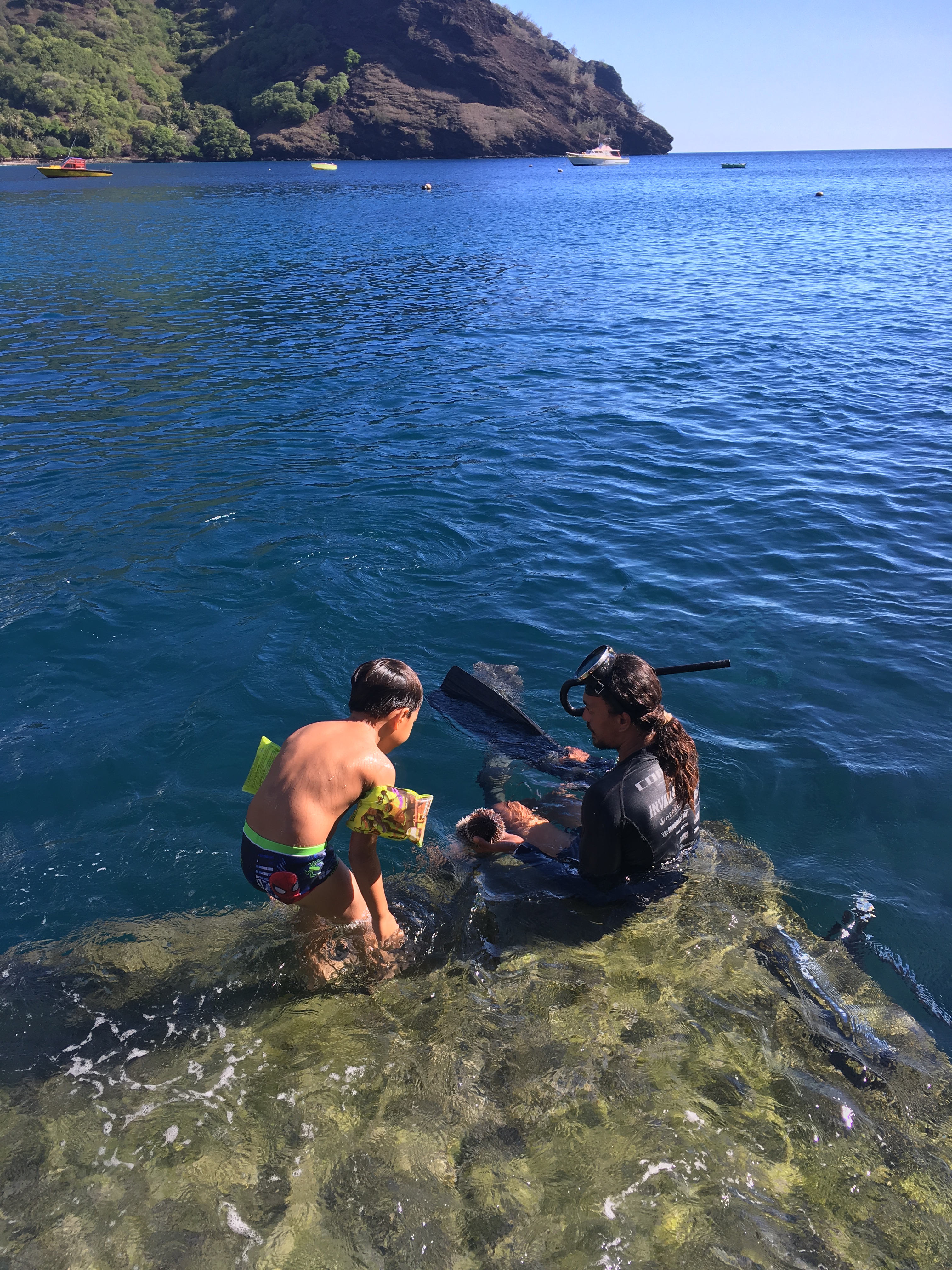
Tehei shows a young boy how to dive for sea urchins, a common snack food (2018).


Tehei’s First Dives (2/3)

“After, when my father went during the daytime to the quai to fish for octopus, I always went with him. And sometimes I was afraid. But my dad sensed this, he could sense it. If a shark was near both of us it could sense my fear too. And my dad said this: ‘You must never have fear. If you are afraid the shark will not leave.’ I was crying then and said, ‘Ah, no, I don’t want this, no!’ Little by little, sometimes after I practiced and practiced and practiced I began to get good at diving. Sometimes I went all by myself. If I told my dad this, he would say, “No, no, no, you must never go alone, it isn’t good.’ But I didn’t listen to him. I would watch my father and if he wasn’t paying me any attention this is what I did: I took the mask and the speargun with the flippers and everything and I went. And when he saw that I wasn’t there he went to look at the fishing materials. When he would see the materials missing he would say, ‘Ah, no, Tehei went diving again!’ I did this all the time.” – Tehei of Vaitahu, Age 31

Tehei’s First Dives (1/3)

“I was seven years old. My dad and Fiu’s dad were in the water. My oldest brother Toua stayed in the canoe to watch over it. And I was little. I said to my dad, I also want to go in the water. My dad said, “No, no, no, no.” In the moment that he dove down, I jumped in the water. I dove behind him. When my dad saw me, he said, “Ah, no, no! Return to the boat! Go, go!” Afterwards I cried and cried and cried, and my dad said, “Come, come.” So I went alongside my father. I had a mask, but no light. I was behind my dad. And my dad, he couldn’t very well fish because he was all the time beside me, watching me. So… there you go. It was night! That was my first dive, in the night” – Tehei of Vaitahu, 31 years old

Original French:

“J’ai sept ans. Eh… mon père avec le pere de Fiu, ete dans la mer. Et mon frère Toua il était le plus grand dans le pirogue pour garder le pirogue. Et moi j’etait petit. Et j’ai disais a mon père, je veux aussi aller à la mer. Mon père a dit, ‘Non, non, non, non.’ Au moment que mon père a plongé, j’ai parti plonger. Parti derrière. Quand mon père a vu, il dit, ‘Ah, non, non! Tu retourne dans le pirogue. Aller aller!’ Apres j’ais pleure pleure pleure, mon père a dit ‘Come, come.’ J’ai etait a coté de mon père. Avec un mask. Mais sans la lumière. Sans lumière. J’étais derrière de mon père. Et mon père, il peut pas bien pêcher parce qu’il était tout le temps la, me surveyer. Ben… voila. La nuit! C’est mon premier plonge. C’est la nuit.”

Diving with Sharks

“When I went fishing with a friend of mine, my friend was in the boat and I was alone in the ocean. So, when I shot the fish [with a speargun], afterwards the spear flew off completely. It fell to the bottom with the fish. I went to recuperate the spear and the fish, but at the same time I didn’t pay attention to what was behind me. I started to swim upwards, with the fish here in my hand, and then the shark came at me from behind. The shark wanted the fish, but he took my hand first. I fought off the shark and then quickly swam to the surface. Once I came into the boat it wasn’t even five minutes before I passed out. I woke up in the infirmary.”

This is a story from champion spearfisherman Hi’o, a man living in the village of Vaitahu. He still has his hand, albeit with some very large scars.

I am currently going through old interviews from my dissertation fieldwork period, so I will be posting a lot of small stories or quotes from people living in the Marquesas. There will definitely be more on sharks in the future.

Original quote:

Quand on été a la pêche, avec un copain, après comme mon copain était sur le bateau, j’étais seul dans la mer. Voila, comment j’ai tiré le poisson après la flèche s’envole carrément, c’est tombé au fond avec le poisson. J’étais aller recouper le harpon avec le poisson, je même pas fait attention derrière moi. Commencé à monter, comme le poisson il est la (points to hand), après, le requin a venu par derrière. Il veut, le requin, il voulait du poisson, mais il a pris d’abord ma main. Comme ca, débattre avec le requin, voilà. Et vite aller à la surface. Arrive dans la bateau même pas cinq minutes ok, K.O. Je me suis reveille à la infirmerie. Voilà.