Heritage Management in the Marquesas Islands

“The UNESCO WHL is intended to help identify, protect, and preserve certain heritage for the benefit of all humanity (UNESCO 2018). Yet, both in reality and in the future imagined by Marquesans, this includes a commoditization of heritage that prioritizes material preservation over attention to ancestral meanings or respect…. Despite intentions to respect local culture and meaning, the recognition of world heritage thus becomes an exercise of power and, ultimately, governance by the state and the global market” (Donaldson 2019, 117).

Working with the Ancestors is a beautiful depiction of the way different groups interact with heritage in the Marquesas Islands, a place close to my heart. Emily Donaldson’s book describes heritage in the Marquesas and the problems Marquesans face in the twenty-first century. One of the issues at the forefront of heritage studies is the way in which UNESCO and other preservationist organizations follow standardized rules of heritage listing and management, which leads to at best an ignoring of local values and at worst a complete dispossession. Donaldson writes, “The UNESCO project has relied primarily on an authorized understanding of heritage fed by nonlocal funding, political influence, and the globally dominant heritage discourse. As with similar cases in nature conservation, the result is an ongoing negotiation between the elite, often global ‘eco-discourses’ of powerful outsiders and local, emplaced knowledge of the land (Campbell 2005, 311). In the process, imposed political, economic, and intellectual influences are driving indigenous peoples to question their own superior knowledge of their surroundings in favor of foreign ‘expert’ opinions” (Donaldson 2019, 127).

As Donaldson points out, the silencing of local and indigenous voices is a problem in both heritage and conservation management. People working in these fields should find ways to uplift indigenous values, instead of subsuming them in the name of global visions (a great book on the clash of indigenous groups and conservation visions is Wild Sardinia: Indigeneity and the Global Dreamtimes of Environmentalism by Tracey Heatherington). This book would be a great read for anybody going into the field of heritage management. “A true commitment to the future of Marquesan culture and the land instead requires an acknowledgement of islanders’ rich social and spiritual relationships with the bush, and the recasting of Marquesan understandings of respect, ownership, and time as a potential asset, not a hindrance, to the preservation of ‘heritage’” (Donaldson 2019, 143).

References:

Campbell, Ben. 2005. “Changing Protection Policies and Ethnographies of Environmental Engagement.” Conservation and Society 3 (2): 280-322.
Donaldson, E. 2019. Working with the Ancestors: Mana and Place in the Marquesas Islands. Seattle, WA: University of Washington Press.
Heatherington, T. 2010. Wild Sardinia: Indigeneity and the Global Dreamtimes of Environmentalism. Seattle, WA: University of Washington Press.
UNESCO 2018. “World Heritage.” http://whc.unesco.org/en/about.

Unsettling Anthropology

“Where might we find Mino-bimaadiziwin, the Good Life, in the midst of chicken nuggets, fries, a text message, and a large pop that just slid around on the tray and spilled sticky liquid on the floor? In our existence of contemporary choices, convenience, and complications, it is not always easy to maintain and continue Anishinaabe knowledge and traditions” (Grover 2017: 72).

What do you think when you read this quote? Depending on what point of view you’re coming from, you might contemplate it differently. Oftentimes, anthropologists and journalists from western countries are too quick to market this as a sign of a disappearing culture. They are reaching for what I call a sort of appropriated nostalgia for a time that wasn’t even their own but that they believe Native cultures should still occupy. Modern day amenities in this way are seen to contradict tradition, as if the two cannot exist in the same time frame.

There is a huge problem with this mindset. Not only does it freeze cultures in an imaginary and romanticized past, but it also assists in the agenda of disappearing Native cultures from the contemporary world. Tuck and Yang (2012) state this as such, “Everything within a settler colonial society strains to destroy or assimilate the Native in order to disappear them from the land – this is how a society can have multiple simultaneous and conflicting messages about Indigenous peoples, such as all Indians are dead, located in faraway reservations, that contemporary Indigenous people are less indigenous than prior generations, and that all Americans are a ‘little bit Indian’” (pg. 9).

This, of course, is not where Grover, an Ojibwe woman from Minnesota, was going with this paragraph in her book Onigamiising. Her book is full of short essays on contemporary, every day lives of Anishinaabeg. She explains,

“I believe that we live in Mino-bimaadiziwin in ways similar to those of our ancestors: in everyday lives that are given to us by the Creator. The beginning of each day is an unopened gift, and as the day goes by, we acknowledge that by doing our best to live the values that have been passed down to use for generations: gratitude, modesty, generosity, and a consideration for others and the world around us. Living a good life is our gift back to the Creator; our daily contributions, big and small (this would include mopping up spilled pop), continue the tradition of Mino-bimaadziwin” (pgs. 72-73).

For western anthropologists (and journalists as well): how can we stop defining others and instead let them define themselves? How can we ‘unsettle’ anthropology and can it ever be used as a tool to assist projects of decolonization? (Unfamiliar with settler colonialism and/or decolonization? Check out these Tuck & Yang’s article, listed in references or read this article by Kyle Powys Whyte). I do believe anthropology has come a long way since the times of Malinowski or Mead but it must continue to change so that it doesn’t continue to perpetuate oppressive colonial agendas. I find myself often asking, is anthropology salvageable? Is this really the path I want to continue to take? What will a future equitable and ethical anthropology look like?

PS. I’m sure there are many anthropologists that are working towards a better, more moral anthropology. I hope to read more of their work in the future and continue posting about this topic! As a white anthropologist, I must continuously recognize my place in the dynamics of power within this academic field and within the societies/cultures I inhabit, and do my best to work against oppressive institutions that I undoubtedly benefit from.

References:
Grover, L.L. 2017. Onigamiising: Season of an Ojibwe Year. Minneapolis: University of Minnesota Press.
Tuck, E. & Yang, K.W. 2012. Decolonization is not a metaphor. Decolonization: Indigeneity, Education & Society 1(1), pp. 1-40.
Whyte, K.P. 2018, April 3. White Allies, Let’s Be Honest About Decolonization. Yes Magazine. https://www.yesmagazine.org/issue/decolonize/2018/04/03/white-allies-lets-be-honest-about-decolonization/

Hunter-Gatherer : Farmer

“The hunter-gatherer mind is humanity’s most sophisticated combination of detailed knowledge and intuition. It is where direct experience and metaphor unite in a joint concern to know and use the truth. The agricultural mind is a result of specialised, intense development of specific systems of intellectual order, with many kinds of analytical category and exacting uses of deductive reasoning. The hunter-gatherer seeks a relationship with all parts of the world that will be in both personal and material balance. The spirits are the evidence and the metaphors of this relationship. If they are treated well, and are known in the right way, and are therefore at peace with human beings, then people will find the things they need. The farmer has the task of controlling and shaping the world, making it yield the produce upon which agricultural life depends. If this is done well, then crops will grow. Discovery by discovery, change by change, field by field, control is increased and produce is more secure. The dichotomies of good and evil, right and wrong express this farmer project: control comes with separating manipulable resources form the rest of the environment and working with determination and consistency against all that might undermine this endeavor” (Brody 2001, p. 306-7).

The starkest differences between hunter-gatherers and farmers, as described by Hugh Brody. Brody also stresses the importance of not seeing hunter-gatherer : farmer as a clear-cut dichotomy, but instead realizing that there is a spectrum of possible livelihood strategies between these two lifestyles.

References:

Brody, H. 2002 [2001]. The Other Side of Eden: Hunter-Gatherers, Farmer and the Shaping of the World. London: Faber and Faber Limited

Learning Nature in the Amazon and Himalayas

“I would suggest that young people in Sacha Loma–given their participation in routinized forms of practice that hinge on the aspiration to future participation in wage-work in the local eco-tourism and service economy–are applying a reasoning frame about local forest species styled on a basic assumption imported from Western-style environmentalism: that non-human environments are fundamentally fragile and in need of protection” (Shenton 2018).

Jeffrey Shenton makes an interesting point about ecological understandings in his article titled, “Going to School in the Forest.” His fieldwork took place in an Amazonian village in Peru. While many similar studies looking at the transmission of ecological knowledge focus on the amount of knowledge younger generations are learning (for example, they may be learning less than elder generations), Shenton looks instead at how children are learning, and how they evaluate the importance of ecological knowledge. He notes that even though children today are going to school during weekdays instead of working on farms as they would have in the past (this is what he calls a sort of habitual reorientation), they are still interacting with the natural world: “Though this community reorientation was far-reaching, it still took place in a context in which young people had consistent access to local biota. School standards, though, indexed a clear division between town activities and forest activities. Students traveling to school went to great lengths to stay meticulously free of the omnipresent rain forest mud, wearing a uniform that included a white polo shirt, dark blue dress pants for boys or skirt for girls, and black dress shoes” (Shenton 2018). Children still learn about the forest, but they do so with a different overarching mindset than their parents may have.

In a similar yet distant case, Jeremy Spoon in his article on tourism in the Himalayas, discusses how younger generations have grown up deeply embedded in a world of tourism, which affects how they perceive their environment: “Younger Sherpa experienced most if not all of their lives so far inside a tourist destination engaged in the host-guest drama. For these individuals, tourism may be causing the land to seem more as a tourism commodity and less spiritually endowed” (Spoon 2012: 52).

In both cases – Peruvian rain forest or Nepali mountains – children continue to interact with their natural worlds daily. For many of them, future jobs in tourism demand that they know their environments well. However, the way in which they are learning about their world has shifted, their daily rituals reoriented, and thus nature reinterpreted. While young Kichwa villagers think that the forest is in need of protection, elders believe it provides useful materials for everyday life. Young Sherpas believe nature should be preserved for tourism, while elders believe it should be protected because of intrinsic spiritual qualities. Neither is necessarily wrong, but as Spoon points out, Western concepts tend to create a human/nature divide, whereas indigenous ones commonly do not. Western environmentalism works well when its values align with local values, but we must also be aware of how it is changing people’s fundamental relationship to knowledge and the environment, creating fences where there use to be none.

References:

Shenton, J.T. 2018. “Going to School in the Forest: Changing Evaluations of Animal-Plant Interactions in the Kichwa Amazon.” Journal of Ecological Anthropology 20(1).

Spoon, J. 2012. “Tourism, Persistence and Change: Sherpa Spirituality and Place in Sagarmatha (Mount Everest) National Park and Buffer Zone, Nepal.” Journal of Ecological Anthropology, 15(1) pp. 41-57.

How Storytelling Makes Us Human

“The social function of shared stories gave rise to what we may call the ‘story memory’ of homo sapiens where our memories are both recalled and shared as stories, creating the ‘social memory,’ and hence identity, of groups. We now recall (through story memory) not only episodes of our own experiences, but also the experiences of long-ago others. This allows for human culture to develop over time in a way unimaginable in the non-hominid kingdom, and allows our stories to function as a vast reservoir of memories, experiences, and aesthetics. We humans now rely on stories, on our discrete categorizations of time, for much of our thoughts about the past. Not only are past events thought of and expressed predominantly in terms of stories, but also the future as well” (Thompson 2010:412).

What makes us human? Many philosophers, sociologists, anthropologists and biologists have asked this question, wondering if and how humans are different from the rest of the animal kingdom. In Tok Thompson’s (2010) essay, “The Ape that Captured Time” he conclusively states that stories are what makes us human: “Without the story, it is clear we would not be human” (412). He backs up this statement by looking at the narrative capabilities of animals and also the history of storytelling among early hominids. Thompson explains that while animals have narrative capabilities – as in, they may be able to narrate information that is presently happening – there is no evidence that they have the ability to tell stories – that is, the ability to communicate episodes from the past or the future.

Anthropologists in the field of multi-species ethnography have also looked at the differences between human and animal communication, exploring further how humans and animals can have inter-species communications. A good book to read if you are interested in this concept is Eduardo Kohn’s “How Forests Think.”

Thompson’s work has interesting implications also for the concept of traditional ecological knowledge, or TEK (which I explained in the previous post). Thompson and anthropologist Tim Ingold might have some very interesting conversations on the storied nature of experience and knowledge. Thompson writes, “Humans can pass down stories; animals do not, and, because of this, the capacity for animal cultures to develop complexity over multiple generations is much more limited” (Thompson 2010:412). Basically, stories are how we pass down information across generations in a meaningful and understandable way. In Ingold’s (2011) essay “Stories against classification,” he sees human knowledge as a matrix of relational stories, passed down and recreated through experience. Ingold writes, “To tell, in short, is not to represent the world, but to trace a path through it that others can follow” (Ingold 2011:162). Both anthropologists see stories as a way to transmit important knowledge from one generation to another.

The ability to connect the present to the past or future, and to communicate this to others, is found to be uniquely human. Stories are how this information is communicated, and we rely heavily on stories to understand our world and to pass information on to future generations. It seems right to say, then, that storytelling makes us human. “We are the only storytellers on Earth” (Thompson 2010:414).

References

Ingold, T. 2011. Stories against classification: transport, wayfaring and the integration of knowledge. In Being Alive: Essays on movement knowledge and description (pp. 156-179). London: Taylor and Francis.

Kohn, E. 2013. How Forests Think: Toward an Anthropology Beyond the Human. Berkeley, CA: Univ. of California Press.

Thompson, T. 2010. The Ape That Captured Time: Folklore, Narrative and the Human-Animal Divide. Western Folklore 69(3-4), pp. 395-120.

Traditional Ecological Knowledge

“Traditional ecological knowledge (TEK) represents experience acquired over thousands of years of direct human contact with the environment. Although the term TEK came into widespread use in the 1980s, the practice of TEK is as old as ancient hunter-gatherer cultures” (Berkes 1993: 1).

Traditional ecological knowledge, or TEK, is a common term used among anthropologists who study indigenous peoples. As Fikret Berkes has described, it is a system of human knowledge relating to the natural environment that has been passed down over many generations. This type of knowledge is gained through intimate experience and observation within the natural world, and is often strongest in places where people depend directly on natural resources. Hunters, fishers, gatherers, agriculturalists, pastoralists, all spend their lives outdoors in communion with the earth’s natural rhythms, and thus it is beneficial to their cultures and lineages to pass down knowledge learned about the environment from parent to child, grandparent to grandchild, aunt and uncle to niece and nephew, or even peer to peer.

Although TEK is essentially situated in time (all TEK is linked to the past), that does not mean it does not change. As Puri (2013) and Ingold (2011) note, knowledge is never copied directly from one person to another. Instead, it is dependent on the individual and how they understand it, experience it, and choose to pass it down.

TEK has important implications for biodiversity. Gagdil, Berkes and Folke (1993), among others, push for higher recognition of indigenous knowledge in fields such as ecology, biology and conservation. Indigenous peoples have been studying their environments for generations, and their observations of recent changes to the world provides vital information about how unpredictable forces such as climate change and pollution are affecting people and their natural environments. Thus, as these three scholars write, “Just as important as it is to conserve biodiversity for sustainability, it is as urgent to conserve the diversity of local cultures and the indigenous knowledge that they hold” (Gagdil, Berkes & Folke 1993: 156).

In Tanzania, as part of a biology class during my Study Abroad in 2013, a Maasai man guides us through the bush teaching us about animal tracks and the useful qualities of native plants.

References

Berkes, F. 1993. Traditional Ecological Knowledge In Perspective. In J.T. Inglis (ed.), Traditional Ecological Knowledge: Concepts and Cases (pp. 1-6). Ottowa, ON: International Program on Traditional Ecological Knowledge.

Gagdil, M., Berkes, F. & Folke, C. 1993. Indigenous Knowledge for Biodiversity Conservation. Ambio, 22(2/3) pp. 151-156.

Ingold, T. 2011. Stories against classification: transport, wayfaring and the integration of knowledge. In Being Alive: Essays on movement knowledge and description (pp. 156-179). London: Taylor and Francis.

Puri, Rajindra. 2013. “Transmitting Penan Basketry Knowledge and Practice.” In R. Ellen, S.J. Lycett, and S.E. Johns (eds), Understanding Cultural Transmission in Anthropology: A Critical Synthesis, pp. 266–99. New York, NY: Berghahn Books.

Ethnographic Acceptance – Griaule et Ogotemmêli (1/3)

“But the Dogon came to recognize the great perseverance of Marcel Griaule and his team in their enquiries, and that it was becoming increasingly difficult to answer the multiplicity of questions without moving on to a different level. They appreciated our eagerness for an understanding which earlier explanations had certainly not satisfied, and which was clearly more important to us than anything else. Griaule had also shown a constant interest in the daily life of the Dogon, appreciating their efforts to exploit a difficult country where there was a serious lack of water in the dry season, and our relationships, which had thus extended beyond those of ethnographical enquiry, became more and more trusting and affectionate. In the light of all this the Dogon took their own decision, of which we learned only later when they told us themselves. The elders of the lineages of the double village of Ogol and the most important totemic priests of the region of Sanga met together and decided that the more esoteric aspects of their religion should be fully revealed to Professor Griaule. To begin this they chose one of their own best informed members, Ogotemmêli who, as will be seen in the introduction, arranged the first interview” (Dieterlen 1965:xvi)

An anthropologist’s dream – after fifteen years of asking questions and getting evasive answers, the Dogon finally decided to reveal to Marcel Griaule the inner-workings of their cosmology and cultural philosophy, their ‘deep-knowledge’ as they called it. Fifteen years! Griaule began his ethnographic work in 1931, and finally in 1947, after building intimate relationships and showing consistent interest in the culture, the elders finally agreed to let him into their world. No matter how long it takes, I expect the feeling of accomplishment and humility is overwhelming when this ultimate form of ethnographic acceptance into the culture finally occurs. The interviews between Griaule and Ogotemmêli are recorded in a book called Conversations with Ogotemmêli (Original French version: Dieu d’Eau). I have just started re-reading this book, it was assigned to me long ago during my freshman year of college in a class called “Egypt the Cradle of Civilization.” I only read bits and pieces during the class, but now, some seven years later, I am excited to re-read and see how my understandings of the book have changed after all of these years of anthropological education. More from Ogotemmêli coming next.

References:

Dieterlen, G. 1965. Introduction. In M. Griaule, Conversations with Ogotemmeli: An Introduction to Dogon Religious Ideas. Oxford, UK: Oxford University Press.

Conversations with Teifituteiki (2/2) – On Getting Old

“He says he had three boats. They were there, he went fishing, he taught his children. He taught his children how to fish, and after awhile he started to get old, alone. And there you go, he stopped fishing a little bit. But, for the morale, he still has the morale to go fishing! Oh yes, he still has the morale. It is enough if somebody comes to find him, ‘Let’s go fishing.’ He will go. He will not wait. He gets up, and he prepares.”

Fishing is often not just a livelihood for Marquesans, but also a pastime. Many fishers talk about “la maladie de la pêche,” or the fishing illness, in which fishers “go crazy” if they haven’t been out on the sea in awhile. As fishers get older, it becomes harder to get out fishing–especially in villages like Hanatetena, where the sea is often rough–but, they often can’t shake the deeply ingrained longing that a true Marquesan fisher will always have inside.

Teifituteiki walks up the road towards the church in Hanatetena.

Original French:

Il disait, il avait trois bateaux. Etait la, il ete a la pêche, il a appris ces enfants. Appris ces enfants pratiquer la pêche, et puis après il a commencé etre vieil, seul. Et voila, il a un peu arrêter la pêche. Mais, pour la morale, il a toujours la morale de aller a la pêche! Ah oui, il a toujours la morale. Il suffit que quelqu’un vient le chercher, ‘on va a la pêche’ s’aller. Il va pas attendre. Il se lève, et il se prépare.

Tehei’s First Dives (3/3)

“After some time, octopus fishing became popular among the youth. They made a competition. I went to my corner, the other boy to his own corner, and we would see who was going to find the most fe’e [octopus]. It was like a game. I was the champion, the champion of hunting octopus. If you don’t believe me it’s not my fault, but it isn’t a tikoi [lie]. After, there were some kids that came to see me. They were a little younger than me, and they wanted to know how I do it. ‘Well,’ I said to them, ‘There is no secret. The secret that I can give you is to catch your breath. You must have a lot of breath. Do not waste it.’ What I meant was, when you dive, you have to avoid moving too much. If you move too much, you are wasting your breath. Voila. And also, there is a technique – when the octopus comes out, you must catch it quick, pull it in quick. Don’t wait until he grabs hold of a rock, because then it will be difficult. If he holds onto a rock, it is then that you will really need your breath. Pull, pull, pull, pull.” – Tehei of Vaitahu, Age 31.

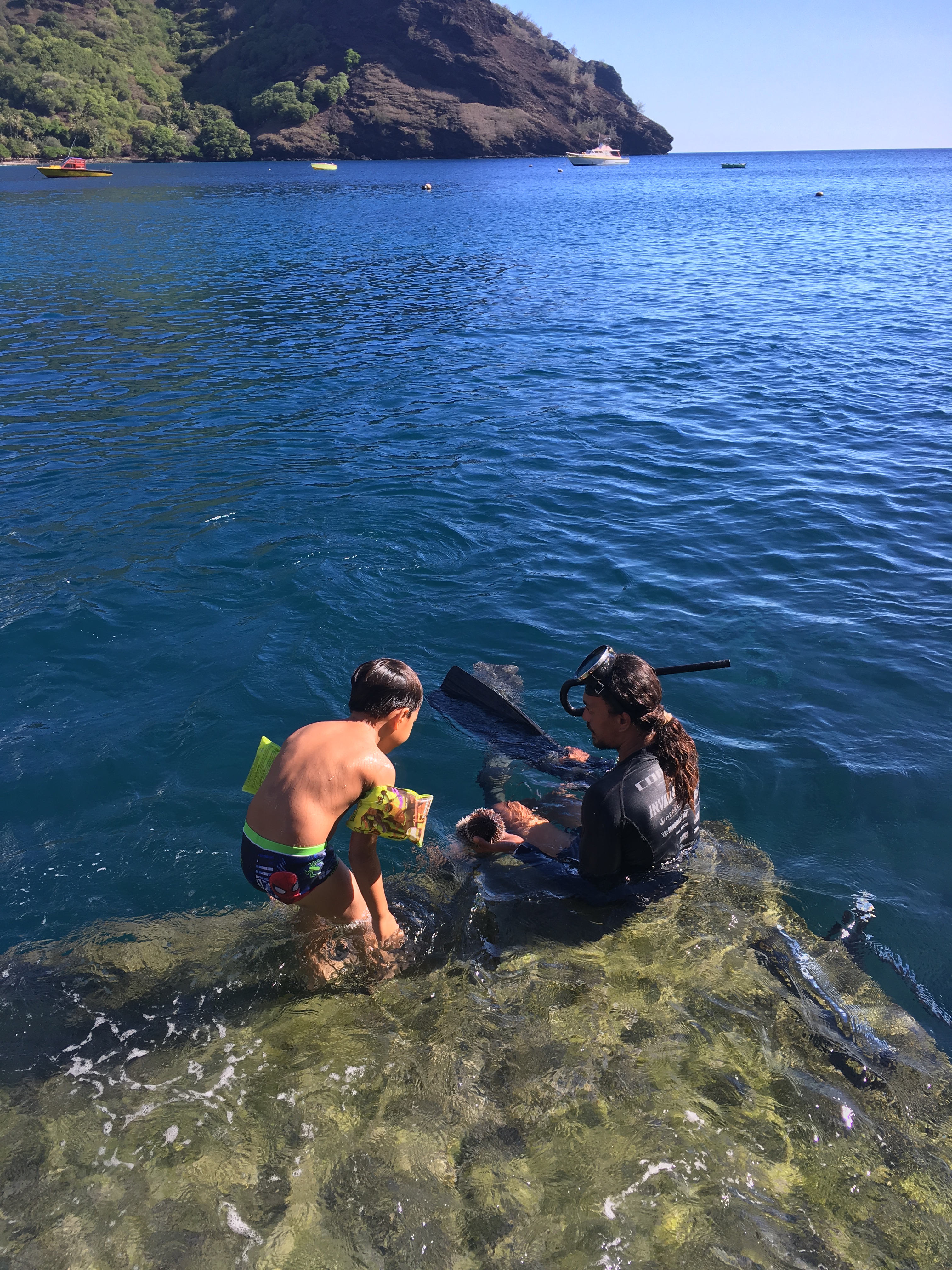
Tehei shows a young boy how to dive for sea urchins, a common snack food (2018).


Fading Cultures

“Every view of the world that fades away, every culture that disappears, diminishes a possibility of life and reduces the human repertoire of adaptive responses to the common problems that confront us all. Knowledge is lost, not only of the natural world but of realms of the spirit, intuitions about the meaning of the cosmos, insights into the very nature of existence” – Wade Davis, Light at the Edge of the World